
Barricade For The Front Row
Stage Barrier Rental in Ottawa
Aluminium barricade for the front of a stage: sections that bolt into one continuous line, standing on a base the audience’s own weight holds down, with a working step behind it for your security team. Held in Ottawa and delivered across the province.
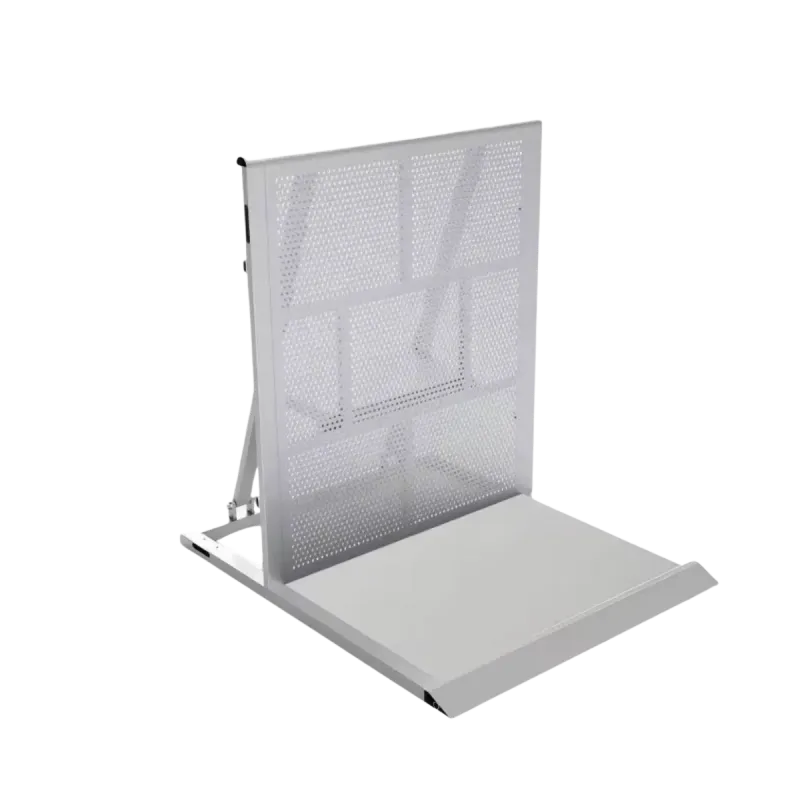
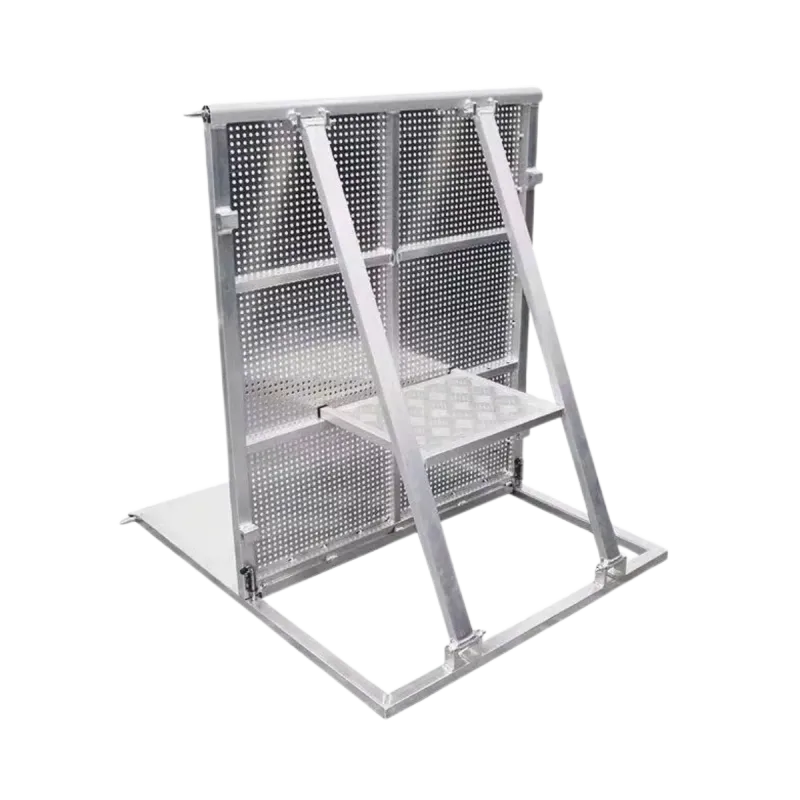
Image 1 of 2
What you’re renting
Every section welds up from three parts — the panel facing the crowd, a brace angled back from it, and the floor at the bottom of that brace. It is the floor that does the clever part. Running 4.1 ft back beneath the front rows, it puts the audience's own feet on the component holding the whole thing still, so pressure on the rail becomes weight on the base. No stakes, no ballast, no drilling.
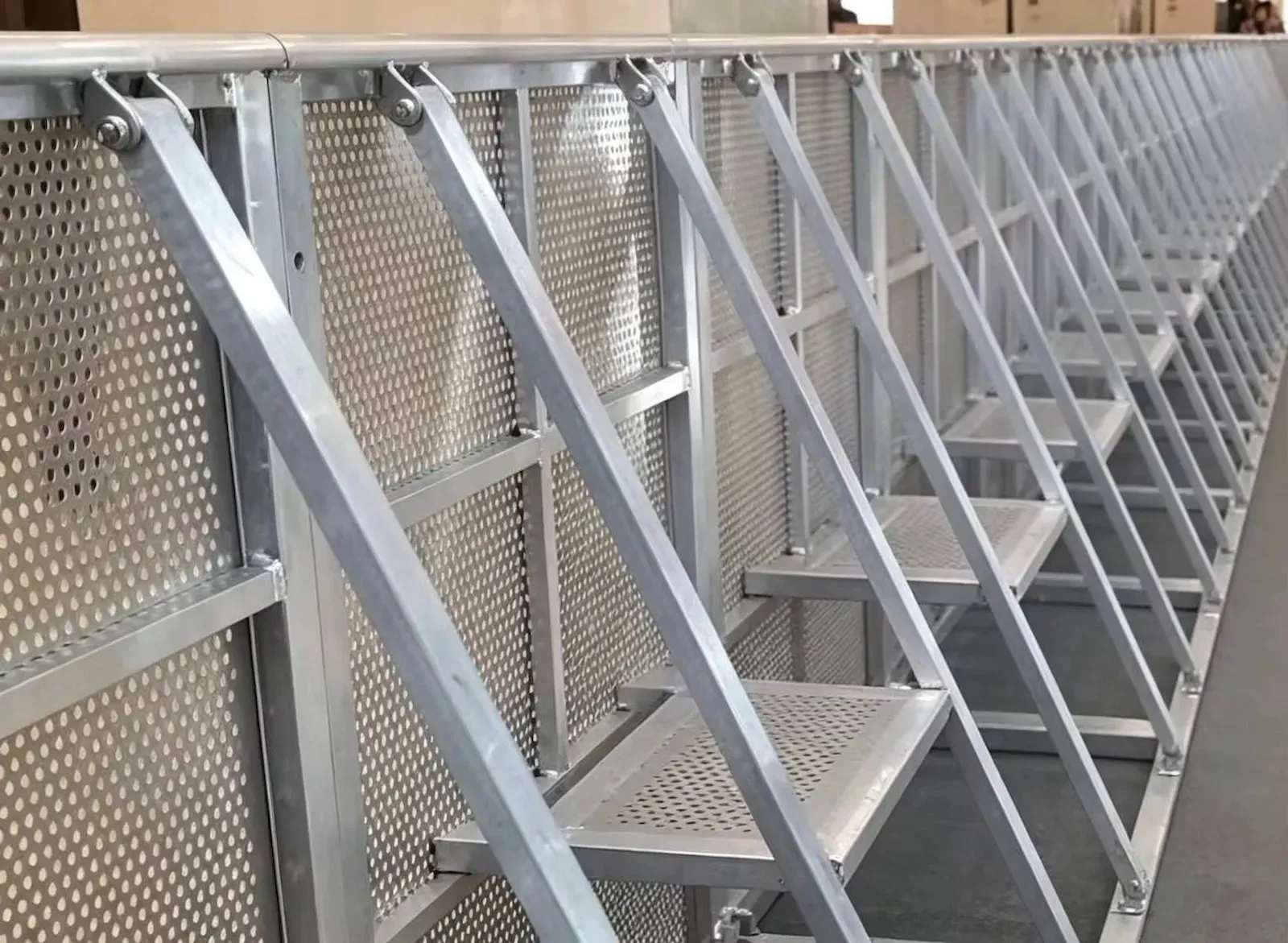
Look at the panel and you will find perforated sheet where an open frame would have bars. That is a climbing decision: a flat face gives a foot nowhere to go. Top rail height is 3.9 ft, putting forearms at a comfortable rest for the front row while keeping a camera lens above it. The crew side carries a step at working height — security's standing position, and the surface anybody lifted out of the crowd comes down onto.
Sections join with a bolt, never a hook, and under load nothing about the run matters more. A hooked joint can walk apart when force runs sideways down the line instead of straight into it. Bolted together, twenty sections behave as a single object: the whole line shifts or none of it does.
Specifications
| Material | Aluminium |
|---|---|
| Section size | 3.3 × 4.1 × 3.9 ft (1 × 1.25 × 1.2 m) |
| Stage front per section | 3.3 ft (1 m) |
| Height at top rail | 3.9 ft (1.2 m) |
| Base depth | 4.1 ft (1.25 m) |
| Front panel | Perforated sheet within the frame |
| Section connection | Bolted, section to section |
| Platform step | At working height behind the panel |
| Rental period | From 1 day to a month+ |
Where stage barriers are used
The test is simple. If the audience will put weight on it rather than walk past it, this is the product:
Front of stage
The main line, holding an audience back from the deck edge and off the monitors.
Working lane for crew
The working corridor behind the rail, occupied by security, medics and photographers throughout.
Splitting the pit
A second line carving an accessible or VIP pit out of general admission, each with an exit.
Media and photo pens
An enclosed position on the rail for accredited photographers, shut off from the crowd behind.
Wrapping the corners
Legs turned back at each end, so lateral force has somewhere to be absorbed.
Protecting the mix position
A boundary around the mix desks, delay towers and every cable run reaching them.
Festival stages on grass
Turf that accepts no stake, leaving the base as the only thing keeping the line in place.
Barricade breaks and egress
Designed-in gaps for staff movement and egress, so no bolt comes out during a show.
Stage barriers or crowd control barriers?
Both count as barrier and a festival usually needs each of them. The deciding factor is not how many people there are but which way they are facing:
Crowd control barriers answer a line people walk beside: a fence line, a closed road, a queue no rope can hold any more. Steel, galvanized, interlocking, and fast to run out over long distances.
Stage barriers answer a line people lean on: a deck front, a pit, a rail the first few rows hold for a whole set. Aluminium, bolted, and held down by the audience standing on its base.
If the job is fencing ground or shutting a road, you want crowd control barriers → instead. Most festival orders list the two together: aluminium at the deck, steel for the rest of the site.
How many stage barriers you need
Sections are the counting unit, and each takes 3.3 ft — one metre — of deck front. A 40 ft stage therefore lands at thirteen and a 60 ft stage at nineteen. The number to measure is the width you mean to hold, not the width of the deck itself, because the line has to overshoot the stage edge rather than stop level with it.
Returns come next, and they are where most plans fall down. Turning each end of the line back toward the stage prevents a crowd folding round the end of it, and every return leg consumes sections in its own right: a pair of 10 ft returns adds three each side, six on top of whatever the front came to. Omitting them is the commonest reason an order arrives short.
A pit split or a photo pen is its own separate run and gets counted the same way. Decide where the barricade breaks go before adding anything up, never after — a gap does not take a section off the total, it turns one run into two, and both of them round up.
Give us the deck width, say whether returns are wanted, and mark any pit split or photo position; the section count arrives with the quote.
Delivery and setup
We deliver province-wide, and taking it away again is part of the same figure rather than a second charge. Barricade is heavier work than steel barrier and every joint has to be bolted through, which is why our crew travels with most of these orders. Give us the site plan and the load-in slot and the line is up and torqued well before doors.
The quote comes back itemised once we have dates, a section count and the site address. Summer festival weekends are what goes first on this product, so those are the dates to lock down; anything else carries no minimum notice.
FAQ
What does it cost to rent stage barriers in Ottawa?
It is priced by the section, and what moves the total is how many the deck front consumes and how many days the show occupies. Tell us the width you are holding, flag any media pen or pit line, add the load-in slot, and an itemised quote follows.
Which of the two does our show need?
Ask which way the audience faces. Walking past the line means steel crowd control barrier — interlocking sections for fence lines, road closures and long queues. Leaning on the line means aluminium barricade, bolted, with the crowd's weight anchoring it. A festival usually books both, one for the deck and one for the site.
Does it need ballast or ground stakes?
It needs neither. With 4.1 ft of base extending back under the first rows, everybody pushing on the rail is also standing on the component resisting them, and the harder the push the more weight that component carries. Which is precisely why it performs on grass, on hard plaza surfaces, and on staging nobody is allowed to put a hole in.
Can gaps be left for medics and security?
Design them in from the start; never carve them out on show day. A barricade break is laid out together with the rest of the run, letting staff through and letting guests be extracted without a single bolt leaving a line under load. Mark the deck width and the openings you want, and the section count arrives already accounting for them.
When should a barricade order be placed?
This product empties fastest over the summer, so any festival date deserves settling a long way out. The rest of the year carries no minimum notice — send through whatever dates exist and we will tell you what is free against them.